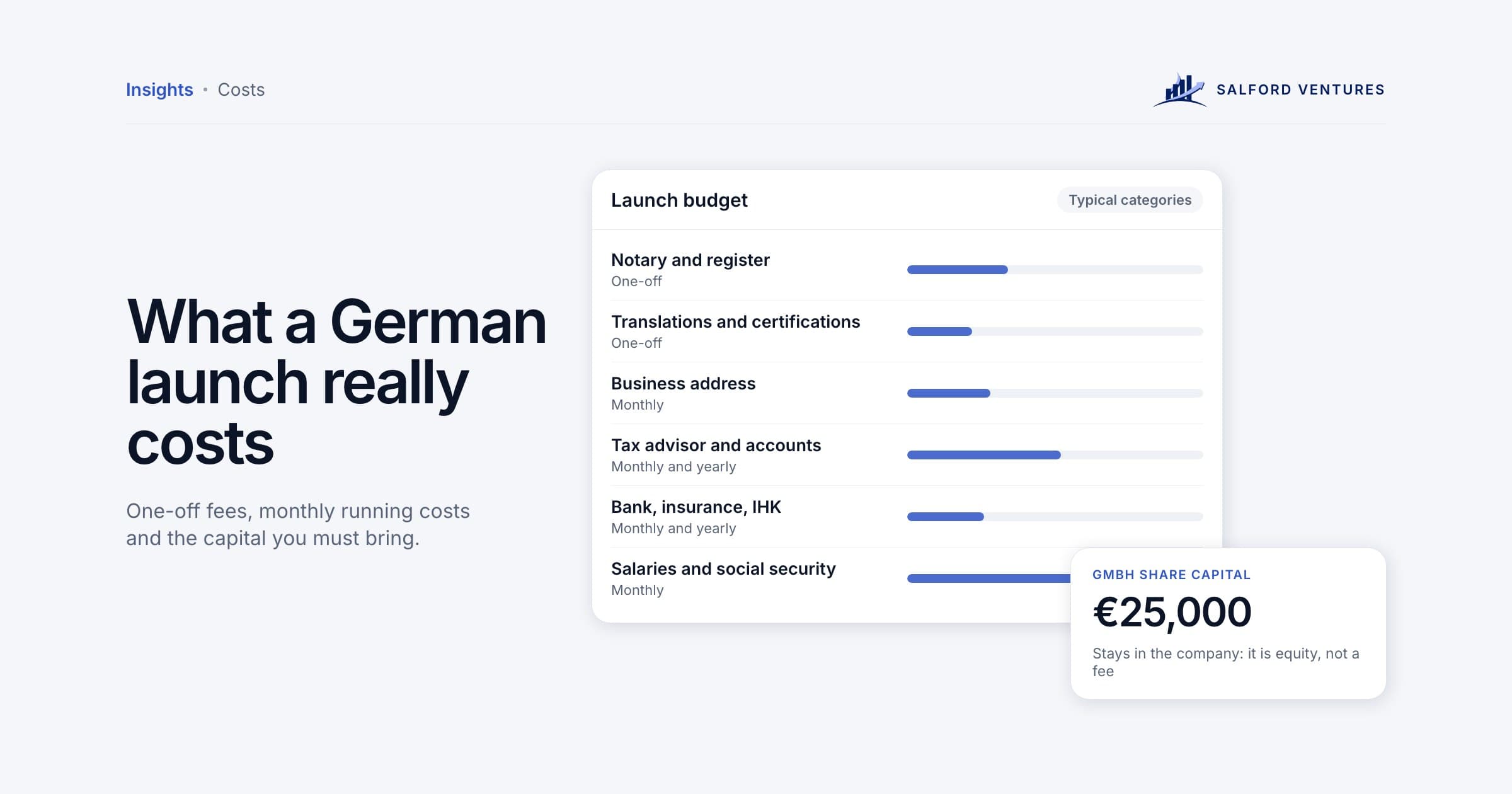
The short version
- The share capital is not a cost: a GmbH needs €25,000 (at least €12,500 paid in at registration) that the company can spend on its business; a UG starts from €1.
- The formation itself is cheap: notary fees of a few hundred euros up to about €1,000, the register court's €300 for a cash formation, a trade registration fee and a small annual transparency register fee.
- The real budget is running costs: the business address, the tax advisor, insurance, travel and, above all, salaries plus roughly a fifth on top for the employer's social security.
- Profits are taxed at roughly 30%: corporate tax with the solidarity surcharge, plus trade tax at the municipality's rate (about 31% in Düsseldorf).
- Plan the months before the first invoice: time without revenue is the line most founders underestimate.
General information, not legal or tax advice. Laws, fees and deadlines change: check the sources and ask a notary, lawyer or tax advisor before you act.
Launching a company in Germany costs far less in legal fees than most founders expect and far more in running costs. A GmbH formation usually costs a few hundred euros to about €1,500 in notary and register fees, plus €25,000 of share capital that stays in the company as its money. The real budget is the monthly cost of operating: a business address, a tax advisor, insurance and, once you hire, salaries plus around 21% in employer social security contributions. The figures below are official where the law sets them and marked as estimates where it does not.
One-off costs of the formation
| Item | Amount | Basis |
|---|---|---|
| Share capital, GmbH | €25,000, at least €12,500 paid in before registration | § 7 GmbHG; equity, not a fee |
| Share capital, UG | From €1, fully paid in | Equity, not a fee |
| Notary, model protocol | Roughly €300 to €450 including VAT | Estimate from the notary fee table, one to three founders |
| Notary, individual articles | Roughly €500 to €1,000 or more including VAT | Estimate; rises with founders, capital and complexity |
| Online founding by video | €25 plus VAT per notarisation on top | Notaries' platform fees |
| Register court | €225 plus €75 provisioning fee for a cash formation; €360 plus €120 with contributions in kind | Register fee schedule |
| Trade registration | €33 for a company in Düsseldorf, plus €13 per further managing director; other cities differ | City of Düsseldorf |
| Translations and document authentication | Priced per document by the translator and the authority | Ask for quotes per document |
How the notary estimate works: German notaries charge by law, from a table keyed to the business value. For a model protocol the value is the actual share capital; for individual articles it is at least €30,000, and a contract between two or more founders costs twice the fee of a one-person formation. The notary also charges for the register application, the electronic data file and expenses, plus VAT. Interpreters and bilingual drafts add to the bill.
Running costs: the part that decides your budget
| Category | When | What drives the amount |
|---|---|---|
| Business address | Monthly | Virtual office, coworking desk or own office; the city; mail scanning and forwarding |
| Tax advisor | Monthly and yearly | Bookkeeping volume, payroll, VAT returns, annual accounts and tax returns; fees follow the tax advisors' fee ordinance or a fixed-fee agreement |
| Bank and payments | Monthly | Account model, cards, international transfers, payment providers |
| Insurance | Yearly | General liability, professional liability, cyber, D&O, depending on what you sell |
| Transparency register | Yearly | €19.80 per year under the fee schedule |
| Chamber of commerce (IHK) | Yearly | Set by the regional chamber, partly by profit; the start-up exemption in § 3 IHKG covers individuals, not a GmbH |
| Travel | Ongoing | Notary, bank and customer meetings; visas for founders from outside the Schengen area |
| Software and website | Monthly | Accounting software, e-invoicing, a German website with an Impressum |
Get written fixed-fee offers for the address and the tax advisor before you sign anything. They are the two recurring lines you commit to in the first weeks, and they are easy to compare.
Salaries: the biggest line
As soon as the company employs people, salaries dominate the budget. On top of the gross salary the employer pays its share of social security: pension 9.3%, unemployment 1.3%, health 7.3% plus half of the health fund's additional contribution, and long-term care 1.8%, which comes to roughly 21% in total, plus statutory accident insurance and small levies. Contributions stop at the 2026 ceilings of €8,450 a month for pension and unemployment insurance and €5,812.50 for health and care, according to the Federal Labour Ministry.
- Minimum wage: €13.90 an hour from 1 January 2026 and €14.60 from 1 January 2027, according to the Federal Government.
- Hiring from abroad: an EU Blue Card requires a gross salary of at least €50,700 in 2026, or €45,934.20 in shortage occupations and for recent graduates; see our article for Indian founders.
- Managing director: a shareholder who is managing director may or may not be subject to social security, depending on the shareholding and the contract. Ask your tax advisor before you set the salary.
Taxes on profit
A GmbH or UG pays corporate tax of 15% plus a 5.5% solidarity surcharge on it, and trade tax of 3.5% multiplied by the municipality's rate. In Düsseldorf the rate is 440%, according to the city's tax office, so the combined burden is about 31% of taxable profit. Under § 23 KStG, as amended in 2025, the corporate tax rate falls by one point a year from 2028 until it reaches 10% in 2032.
VAT is not a cost for most business-to-business companies, but it affects cash flow: you invoice it, pay it over to the tax office and reclaim the VAT on your own purchases. Your tax advisor sets up the returns.
The two lines founders underestimate
- Time. Every week between the decision and the first invoice is a week of rent, salaries and travel without revenue. A well prepared launch saves more money than any fee negotiation.
- Salaries and their overheads. The employer's social security, recruiting, equipment and the months before a new hire is productive add up quickly. Budget the full employer cost, not the gross salary.
When each cost arrives in the first year
| Phase | What you pay | What to have ready |
|---|---|---|
| Before the notary | Translations and document authentication, travel, the first month of the business address | The structure on one page, the signing route, quotes from two banks |
| Formation | Notary, register court, the share capital paid in | Cash for the capital before the filing; the notary invoices after the deed |
| Months 1 to 3 | Tax advisor set-up, bank, insurance, trade registration, the first transparency register fee | Fixed-fee offers signed; the tax office questionnaire filed within a month |
| Months 4 to 12 | Salaries and social security, running costs, the IHK assessment, the annual accounts at year end | A monthly cash plan that shows the runway until revenue covers costs |
The table matters for cash, not for the total: the capital and the first salaries leave the account long before customers pay. Plan the months, not just the year.
Ways to keep the launch lean
- Use the model protocol when the structure is simple: lower notary fees and a faster appointment.
- Prepare documents before the appointment, so the notary does not need a second meeting or extra drafts.
- Start with a virtual office or a coworking desk and move into your own office when the team grows.
- Agree a fixed monthly fee with your tax advisor for bookkeeping, payroll and VAT returns, with the annual accounts priced separately.
- Hire after the first customer conversations, not before: the first German hire is the biggest commitment you make.
- Check programmes before you incorporate, because some stipends must be applied for before the business is registered; see getting funding-ready.
Your launch budget, line by line
Put a number next to each line
- Share capital (GmbH or UG) and any shareholder loan for the first months.
- Notary and register court, including interpreter or bilingual deed if needed.
- Translations and document authentication.
- Business address for at least 12 months.
- Tax advisor: set-up, monthly bookkeeping and payroll, annual accounts.
- Bank, insurance, transparency register, chamber of commerce.
- Salaries plus about 21% employer social security, recruiting and equipment.
- Travel and visas.
- A reserve for delays: at least two months of running costs.
How Salford Ventures helps
The cost calculator in our chat gives you a rough range for your set-up in a few minutes: GmbH or UG, team size, office and accounting. Our Germany Launch package is the easy way to get the formation, address, bank and tax advisor coordinated as one plan; notaries and tax advisors do the regulated work.
Ask Salford
Questions about what a German launch costs? Ask me.
Answers from Salford's own guides, in seconds. A person from the team follows up if you want.