The short version
- Funding-ready means three things: you are eligible, your plan and numbers hold up to scrutiny, and your company and documents are in order before anyone asks.
- Timing rules disqualify more founders than weak ideas: many programmes must be applied for before you start the project, and the Gründungsstipendium.NRW before you register the business.
- Most programmes need a seat or establishment in Germany or the federal state, so the structure of a foreign founder's launch decides which money is open to them.
- Investors and banks check the same core: a driver-based financial model, a clean cap table, a clear use of funds and a data room you can open the day they ask.
- Preparation does not guarantee money. It gives every application and every pitch a fair chance and saves months of back and forth.
To get funding-ready in Germany, check your eligibility for the right public programmes (Förderprogramme) before you incorporate or start the project, build a business plan and a driver-based financial model that a bank or a jury can follow, set up the company and the cap table cleanly, and prepare a data room with the documents investors ask for. Then decide the order: stipends and grants first, promotional loans where you can service debt, and business angels or seed funds when you have traction to show.
What funding-ready means
| Funder | Checks first | What usually fails |
|---|---|---|
| Public stipends and grants | Eligibility, innovation, timing of the application, the seat in Germany or the state | Applying after the project or the registration started |
| Promotional loans via your bank | Ability to repay, own contribution, a business plan the bank can credit-check | Numbers that cannot explain the repayments |
| Business angels | The team, the problem, early traction, the terms | No clear use of funds, a messy cap table |
| Seed funds | Market size, traction, a repeatable way to win customers, the cap table | A deck without a model behind it |
Förderprogramme that fit early-stage founders
Germany has hundreds of programmes at federal, state and EU level. The federal Förderdatenbank is the official search: filter by your state, by "Existenzgründung" and by the type of support. These are the programmes early-stage founders meet most often:
- EXIST-Gründungsstipendium. For founders from universities and research institutions: a monthly stipend for up to 12 months, from €1,000 for students to €3,000 for doctorate holders, plus material costs and coaching, under the 2023 guideline. You apply through the university's start-up network, and the company must not exist yet when funding starts.
- Gründungsstipendium.NRW. €1,200 a month for up to 12 months for up to three founders of an innovative small company with a seat, branch or subsidiary in North Rhine-Westphalia, under the guideline in force since 1 October 2026. You need a recommendation from an accredited founders' network and must apply before the trade registration or the commercial register entry, according to NRW.BANK.
- KfW ERP-Gründerkredit StartGeld. Loans of up to €200,000, up to €80,000 of it for working capital, for businesses less than five years old, applied for through your bank; KfW takes 80% of the bank's risk (KfW/)). KfW has closed the larger ERP-Gründerkredit Universell/) to new applications; ask your bank about its successors.
- NRW.BANK.Gründung und Wachstum. Promotional loans for founders and young companies in North Rhine-Westphalia, also through your bank (NRW.BANK).
- INVEST. A federal grant of 15% to business angels who buy new shares in a young innovative company; complete applications must reach BAFA by 31 December 2026 (Förderdatenbank). More in our guide to raising a first round.
Many grants count as de minimis aid under EU state aid rules, which cap such aid at €300,000 per undertaking over three years (Regulation (EU) 2023/2831). Keep a list of every subsidy you receive: later applications will ask for it.
What foreign founders need to know
- The seat decides. Most programmes require the company, or a branch, to sit in Germany or in the funding state. Plan the structure of your launch with the programme in mind.
- Personal stipends have personal rules. University-based stipends need the university link; some programmes exclude people who receive other living-cost support.
- Banks still decide loans. Promotional loans run through your bank, which assesses the founders and the plan. A founder new to Germany needs a plan the bank can follow without a local track record.
- Visas and funding interact. A residence permit for self-employment asks for secured financing; a funding commitment can be part of that evidence.
The documents that make you fundable
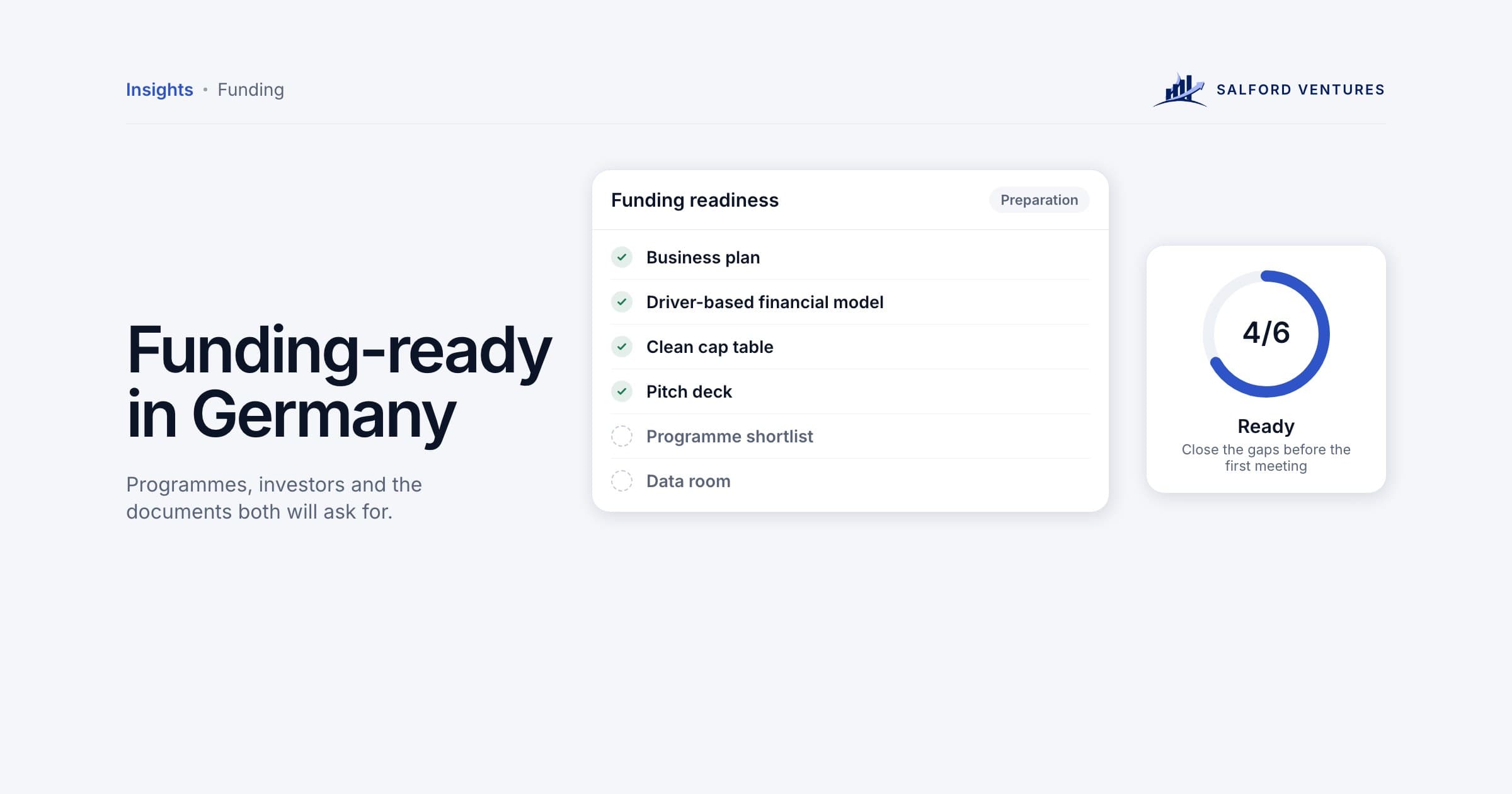
Prepare these before the first application or meeting
- Business plan: the problem, the customer, the market, the offer, the go-to-market plan, the team and the risks, in 10 to 20 pages, in German for German programmes and banks.
- Driver-based financial model: revenue built from customers, prices and conversion, costs from headcount and contracts, monthly for the first 24 months, then yearly to year five, with a cash runway.
- Use of funds: what the money buys and which milestone it reaches.
- Cap table: who holds what, any convertible loans and options, and what the next round does to it.
- Pitch deck: 10 to 15 slides that match the model's numbers exactly.
- Company documents: register extract, articles, shareholder list, transparency register entry, key contracts, IP assignments from founders and freelancers.
- Data room: all of the above in one folder structure you can share the day someone asks.
The single most common gap is the link between the deck and the model. If a slide says the company reaches a revenue level in year three, the model must show how: which customers, at which price, with which team. Funders check that line first.
What a bank reads in your plan
Promotional loans are granted by your bank, so the plan has to work for a credit analyst, not only for a jury. Banks look for:
- Repayment capacity: a cash flow that covers interest and repayments after the grace period, with a margin.
- Own contribution: what the founders put in themselves, in money or in work already done.
- Plausible assumptions: prices, conversion rates and salaries that match the market, with a source or a reason for each.
- Qualified founders: experience in the industry or in running a business, shown in short CVs.
- A downside case: what happens if sales start three or six months later than planned.
The same model then serves the investor conversation: investors read the upside, banks read the downside, and both check that the numbers add up.
Put the money in the right order
- Before incorporation: check stipends that must be applied for first, and decide the structure accordingly.
- At launch: cover the first months with founders' capital, a stipend or a promotional loan if the business can service it.
- With first traction: business angels, possibly with INVEST while it runs, then pre-seed or seed funds.
- At every step: keep the model, the cap table and the data room current, so each next conversation starts from a finished file.
Mistakes that cost founders their funding
- Registering first and checking programmes later, which closes stipends that require an application before registration.
- A deck and a model that disagree, so the first question in every meeting is about the numbers rather than the business.
- Pitching investors before the company and cap table are clean: missing IP assignments or an unclear shareholder list stall due diligence.
- Counting on one programme. Terms change and budgets run out; plan a second route for every month of runway.
How Salford Ventures helps
Our financial strategy work is preparation: the business plan, the driver-based financial model, a shortlist of programmes that fit your stage and structure, and the documents investors ask for. We do not promise funding; the decision stays with the programme or the investor, and tax advisors and lawyers handle the regulated parts. For the pitch itself, get a free deck review or a full deck rebuild.
Ask Salford
Questions about funding in Germany? Ask me.
Answers from Salford's own guides, in seconds. A person from the team follows up if you want.