The short version
- Indian citizens and Indian companies can own a German GmbH, and the managing director can live in India; living and working in Germany needs a separate residence permit.
- Germany objected to India's accession to the Apostille Convention, so Indian apostilles are not accepted in Germany: sign before a German consular officer in India or appear in person.
- India and Germany have a double taxation agreement; it caps German withholding tax on dividends at 10%, with relief claimed from the Federal Central Tax Office.
- Plan the bank account early: identifying a managing director who lives in India and a parent company outside the EU is where weeks get lost.
- With documents prepared, six to eight weeks from decision to a company that can invoice is a realistic plan; residence permits run on their own timeline.
General information, not legal or tax advice. Laws, fees and deadlines change: check the sources and ask a notary, lawyer or tax advisor before you act.
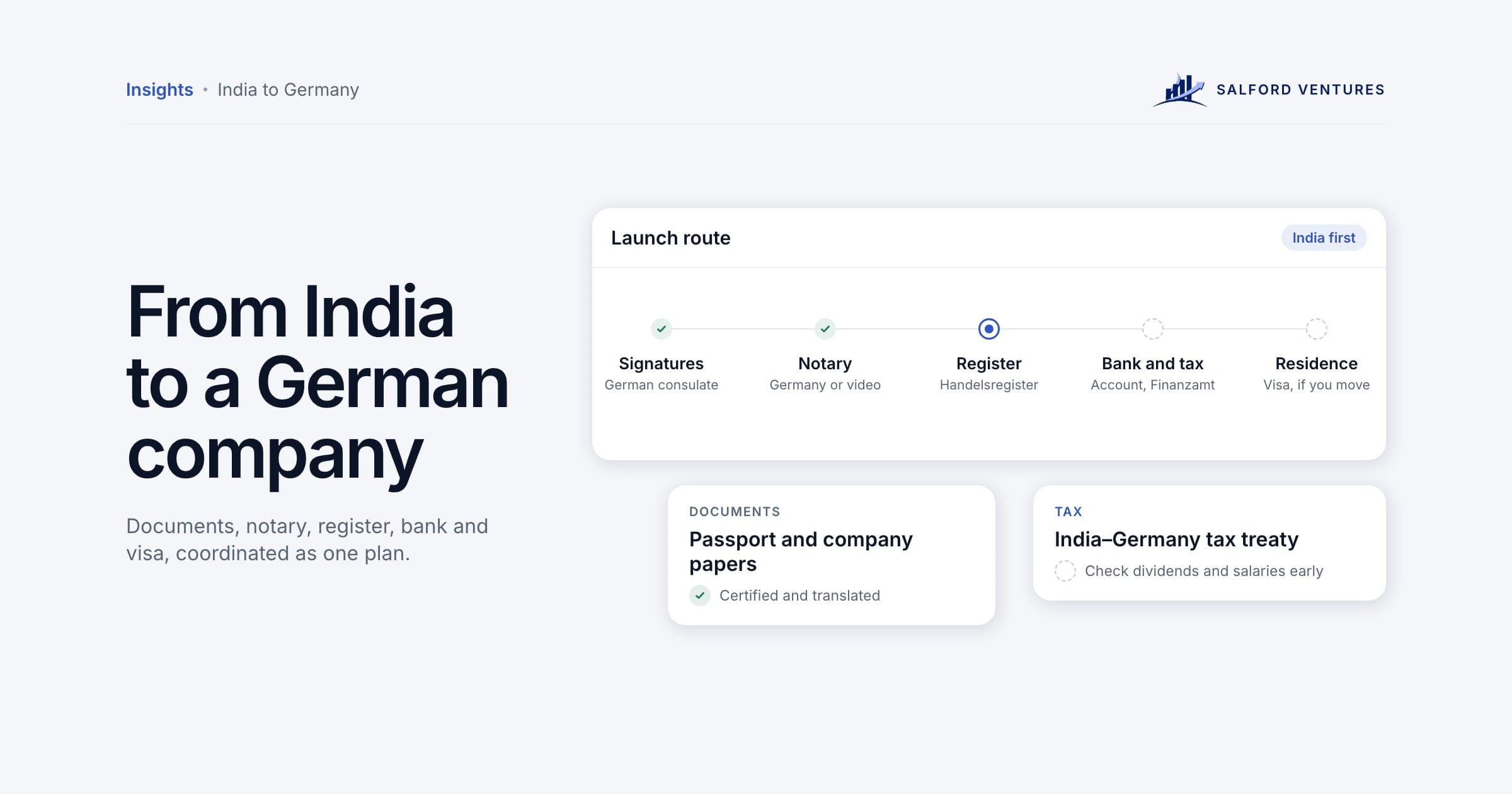
To launch your company in Germany from India, most founders set up a German GmbH (or the smaller UG), owned by them personally or by their Indian company, with a managing director who may live in India. The founding happens before a German notary, after which the company is entered in the commercial register and registered for tax. India-specific planning is needed in four places: how your Indian documents are accepted, the India–Germany tax treaty, the German bank account, and visas if anyone will travel or move to Germany.
The general process is in our guide to setting up a GmbH as a foreigner. This article covers what is different when the founders or the parent company are Indian.
Choose the structure: personal shares or an Indian parent
| Option | Works well when | Plan for |
|---|---|---|
| Founders hold the shares personally | A new venture built for the German or European market | Personal tax on dividends in India and Germany; founders' own documents only |
| An Indian company holds the shares | An Indian business opening a German subsidiary | Board resolution, register extract and ownership chain; India's overseas investment rules; transfer pricing |
| A mix, for example founders plus a parent | A spin-off or a joint venture | Individual articles of association and a shareholders' agreement |
If an Indian company invests, India's rules on overseas investment under FEMA apply, and the investment usually runs through your authorised dealer bank in India. Agree the timing with your chartered accountant before money moves, so the German capital payment is not held up.
Indian documents: no apostille route
India joined the Hague Apostille Convention in 2005 (see the Hague Conference's status table), but Germany objected to India's accession, and the German Missions in India state that the Convention does not apply between Germany and India. Legalisation by the German missions stopped in 2000. Instead, a German court or authority can ask the mission to verify an Indian document, which private individuals cannot start themselves; the missions quote about six weeks plus delivery and a fee paid by the requesting authority, according to their information on Indian documents.
In practice founders avoid relying on Indian public documents where they can:
- Sign before a German consular officer. German consular officers in India can certify signatures and documents for use in Germany, and such documents rank equally with those executed before a German notary, according to the German Missions in India. A power of attorney for the founding is the classic case. Book early: appointments are limited.
- Appear in person in Germany. The notary identifies you with your passport, and an interpreter or a bilingual deed covers the language.
- Ask the notary early about company papers. If an Indian company is a shareholder, the notary decides how its existence and representation are proven. Allow two months or more if the register court asks the mission to verify a document.
The India–Germany tax treaty
India and Germany signed their double taxation agreement on 19 June 1995. It decides which country may tax profits, dividends, royalties and salaries, and how double taxation is relieved. Three points matter most for a new German company with Indian owners:
- Dividends. Germany withholds 26.375% on dividends under domestic law (25% plus the solidarity surcharge). Under Article 10 of the treaty the German tax on dividends paid to an Indian resident is capped at 10% of the gross amount; the difference is reclaimed, or for companies exempted in advance, through the Federal Central Tax Office.
- Transfer pricing. Services, licences and loans between the Indian parent and the German GmbH must be priced at arm's length and documented. Agree the model with tax advisors in both countries before the first invoice.
- Salaries and directors. Where a managing director's pay is taxed depends on where the work is done and on the treaty. A director who lives in India and travels to Germany needs a plan, not a guess.
Germany taxes the GmbH's profit with corporate tax (15% plus the solidarity surcharge) and municipal trade tax; in Düsseldorf the trade tax multiplier is 440%, which adds up to roughly 31% in total. The corporate tax rate falls by one point a year from 2028 to 10% in 2032 under a 2025 law.
The German bank account
The share capital must be paid into an account of the company in formation, and the bank confirms the payment for the register. Banks must identify the managing director and the beneficial owners, which is harder when they live in India and when an Indian company sits in the ownership chain. Ask two or three banks before the notary appointment: whether they accept a managing director resident in India, how identification works (in a branch, by video, by a partner abroad), which documents they need and how long the opening takes. Have a second option ready.
Visas and residence: three different questions
| You want to | What it needs | Source |
|---|---|---|
| Own and manage the GmbH from India | No German residence permit | GmbH Act |
| Travel to Germany for the notary, the bank or customers | A Schengen visa for short business stays | German Missions in India |
| Live in Germany and run your own company | A residence permit for self-employment: economic interest, positive effects and secured financing | § 21 AufenthG |
| Live in Germany as an employee of the GmbH | For example an EU Blue Card: in 2026 a salary of at least €50,700, or €45,934.20 in shortage occupations and for recent graduates | Make it in Germany |
Which route fits a founder who is also managing director depends on the shareholding and the role; the foreigners' authority decides, and an immigration lawyer can assess your case. The Blue Card thresholds rise each year with the pension contribution ceiling, so check the current figures before you plan a hire.
A realistic plan from India
Before you book the notary
- Structure decided: who holds the shares, who is managing director, GmbH or UG.
- Signing route decided: German consulate in India, in person in Germany, or online with a European ID.
- Company papers of an Indian shareholder discussed with the notary, with translations ordered.
- Two banks asked about non-resident directors and Indian parent companies.
- A German business address with reliable post handling.
- A tax advisor in Germany and your chartered accountant in India aligned on dividends and transfer pricing.
- Visa appointments booked for anyone who must travel.
Remember the time difference: Germany is three and a half hours behind India in summer and four and a half in winter, so notary and bank calls work best in the German morning. Our free Germany Launch Playbook has the full 8-week plan and a chapter for founders from India.
Mistakes Indian founders can avoid
- Counting on an Indian apostille. It is not accepted in Germany; plan the consulate appointment or the trip instead.
- Moving money before the Indian side is in order. An overseas investment that has not been routed and reported correctly can hold up the capital payment.
- Booking the visa last. Schengen visa appointments for the notary or bank trip can take weeks; book them when the structure is decided.
- Invoicing between parent and subsidiary without a transfer pricing model. Fixing prices after the first year is harder than agreeing them before the first invoice.
- A managing director who cannot be reached in German business hours. Banks, courts and customers expect answers in the German working day.
How Salford Ventures helps
From our office in Düsseldorf we coordinate the German side of your launch: structure, documents, notary appointment, bank, tax advisor, business address and first customers. Notaries, lawyers and tax advisors do the regulated parts. See the India page, take the readiness check or book a call.
Ask Salford
Launching from India? Ask me.
Answers from Salford's own guides, in seconds. A person from the team follows up if you want.