The short version
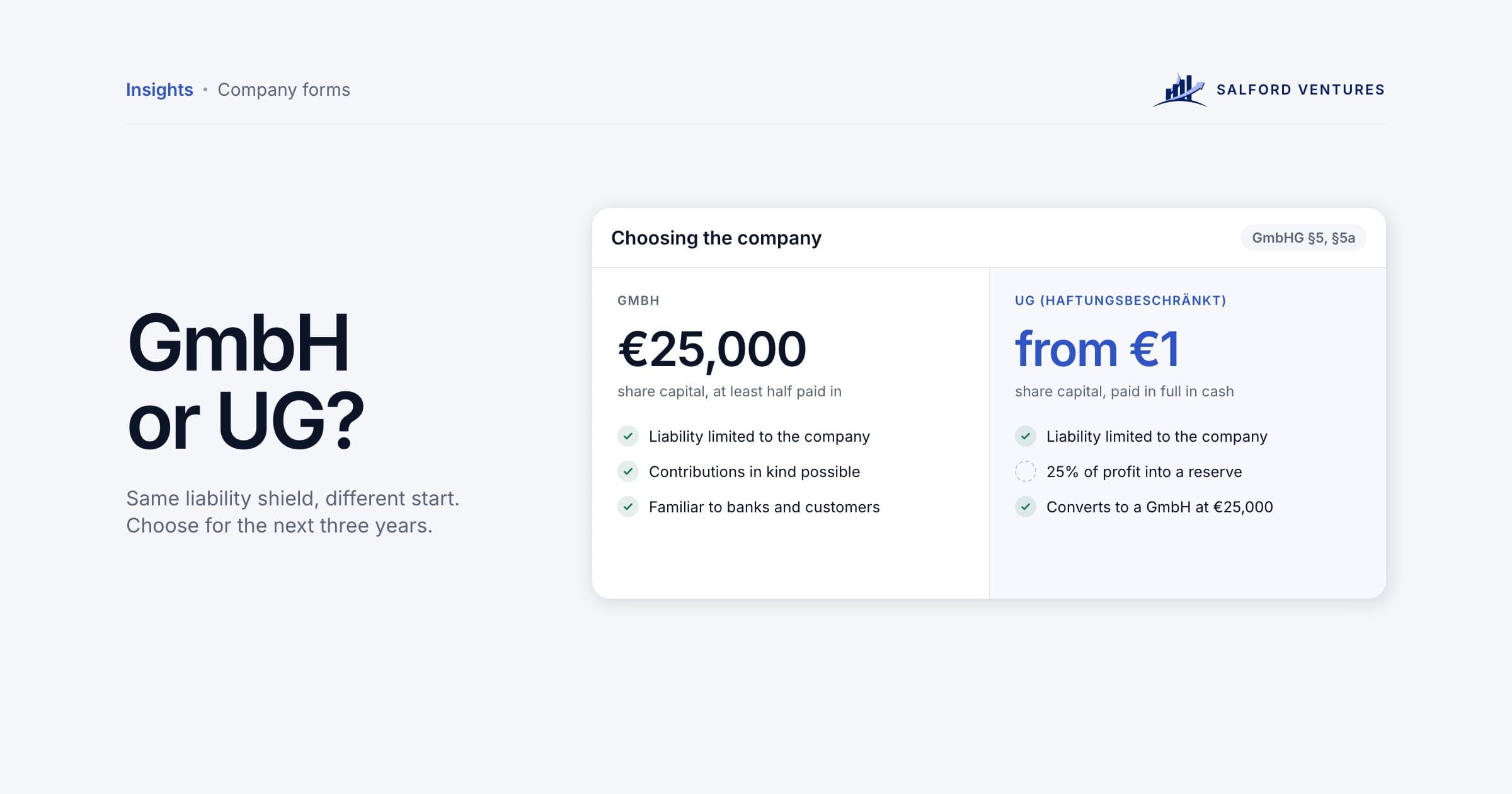
- The UG (haftungsbeschränkt) is not a separate company type: it is a GmbH that may start with less than €25,000 share capital, from €1.
- A UG must pay its capital in full and in cash, cannot take contributions in kind at formation and must keep 25% of each year's profit as a reserve until it reaches €25,000.
- A GmbH needs €25,000 share capital, of which at least €12,500 must be paid in before registration; it reads as the standard to banks, landlords and larger customers.
- Liability, taxation and the founding process are the same; a UG becomes a regular GmbH once its capital is raised to €25,000.
- Choose by what the next two to three years need: credibility and a raise point to the GmbH, a lean market test points to the UG with enough cash behind it.
General information, not legal or tax advice. Laws, fees and deadlines change: check the sources and ask a notary, lawyer or tax advisor before you act.
For most founders launching in Germany the choice is between a GmbH (Gesellschaft mit beschränkter Haftung) and a UG (haftungsbeschränkt), the "mini GmbH". Choose the GmbH if you need credibility with banks, landlords and larger customers or plan to raise investment soon; it needs €25,000 share capital, at least €12,500 paid in at registration. Choose the UG if you want to test the market with little capital: it can start from €1, but must keep a quarter of each year's profit until its capital reaches €25,000. Liability is limited and taxes are the same in both.
One law, two starting points
The UG is regulated in § 5a GmbHG: it is a GmbH whose share capital is below the minimum of €25,000 set by § 5. Everything else in the GmbH Act applies to both: the notarial formation, the managing director's duties, the commercial register, the shareholder list, corporate tax and trade tax. The name tells the market which one you chose, because a UG must call itself "Unternehmergesellschaft (haftungsbeschränkt)" or "UG (haftungsbeschränkt)", never just "GmbH".
GmbH and UG side by side
| GmbH | UG (haftungsbeschränkt) | |
|---|---|---|
| Minimum share capital | €25,000 | €1 (any amount below €25,000) |
| Paid in before registration | A quarter of each cash share, at least €12,500 in total | All of it |
| Contributions in kind | Allowed, fully paid in and valued | Not allowed at formation |
| Statutory reserve | None | 25% of the annual net profit, less losses carried forward |
| Liability | Limited to company assets | Limited to company assets |
| Taxes | Corporate tax, solidarity surcharge, trade tax | The same |
| Extra duty | None | Call a shareholders' meeting at once if insolvency threatens |
| Becomes a GmbH | Already is | When the capital is raised to €25,000 |
Sources for the table: § 5a GmbHG for the UG rules and § 7 GmbHG for what must be paid in before the filing.
What the capital really means
Share capital is not a fee and not a deposit you get back. It is the company's equity: money the company can spend on salaries, rent and marketing from the day it exists. What the law protects is that it is really paid in and is not handed back to shareholders in disguise.
That is why the €1 UG is a trap if you read it as "cheap". A company with almost no equity can be over-indebted from its first invoice, and its managing director must then file for insolvency without delay under § 15a InsO. In practice founders give a UG enough capital or a funding commitment to cover the first months, and many choose a few thousand euros rather than one.
The UG's 25% reserve
A UG must put a quarter of each year's net profit, reduced by any loss carried forward, into a statutory reserve. The reserve may only be used to raise the share capital from company funds or to offset losses, not to pay dividends. Once the capital reaches €25,000, the special rules end and the company is a regular GmbH; it may keep "UG" in its name.
For a founder who plans to reinvest profits anyway, the reserve costs little. For a holding structure that wants to pay dividends to a parent company abroad early, it is a real constraint worth discussing with your tax advisor.
Do the costs differ?
Less than founders expect. The steps and the register court's fee are the same: €225 for a cash formation plus a provisioning fee of a third, under the register fee schedule. Notary fees depend on the business value and the template. With the statutory model protocol (§ 2 (1a) GmbHG and its annex) the notary charges on the actual share capital without the usual €30,000 minimum value (§ 105 GNotKG, § 107 GNotKG), so a low-capital UG with the model protocol is the cheapest formation there is. With individual articles, the difference between a UG and a GmbH in notary fees is small.
The bigger cost difference is the capital itself: €12,500 at least in the account for a GmbH at registration, versus whatever you choose for a UG. For the full picture, see what it really costs to launch a company in Germany.
How banks, customers and investors read it
- Banks and landlords look at equity. A GmbH with €25,000 subscribed reads as a business that has committed money; a €1 UG may be asked for personal guarantees or a deposit.
- Larger customers run supplier checks. A UG is legitimate, but some procurement teams treat a thinly capitalised supplier as a risk, especially for long contracts.
- Investors are used to the GmbH. A UG can take investment, and the capital increase in a round often lifts it above €25,000 anyway, but founders planning a round soon usually start as a GmbH.
- Founders from abroad often benefit from the GmbH's signal, because the company is new in Germany and has no local track record yet.
A simple rule for choosing
Choose the GmbH if two or more of these apply
- You sell to larger German companies or the public sector.
- You need a lease, a credit line or a payment provider that checks equity.
- You plan to raise money from investors in the next one to two years.
- A parent company abroad will hold the shares and wants dividends early.
- You can commit at least €12,500 at registration without starving the business.
Otherwise a UG with realistic capital is a sound start, and you can raise the capital to €25,000 later, from profits or new money. Whichever you choose, decide early between the model protocol and individual articles: several founders, vesting and investor rights need individual articles.
Two examples (hypothetical)
- An Indian software company opens a German sales subsidiary. It will sign framework contracts with large customers, rent an office and hire two account managers. Choose the GmbH: the €25,000 capital and the familiar form help in every supplier check, and the parent can fund it easily.
- Two founders test a consulting offer for German SMEs. They want to sign the first three customers before hiring anyone. A UG with a few thousand euros of capital and a written plan for the first six months is enough; they raise the capital once the business carries itself.
From UG to GmbH later
Starting as a UG does not lock you in. The upgrade is a capital increase to at least €25,000, decided by the shareholders and notarised, then filed with the commercial register. It can be funded in three ways, and many companies combine them:
- From the reserve and other retained profits, as a capital increase from company funds, based on an approved balance sheet.
- With new cash from the existing shareholders.
- In a financing round, when an investor's contribution lifts the capital above the threshold.
Once the capital reaches €25,000, the reserve duty and the other special rules for the UG end. Plan the step with your notary and tax advisor, especially if a round is coming: doing the conversion and the round in one deed can save a second appointment.
Mistakes to avoid with either form
- Paying in the capital and spending it before registration in ways that cannot be shown. Keep the bank confirmation and use the money for the business.
- Calling a UG a GmbH on the website, in contracts or on invoices. The full legal name belongs everywhere the company appears.
- Choosing the model protocol when you need vesting or investor rights. Rewriting the articles later costs another notary appointment.
How Salford Ventures helps
We help founders from abroad decide the structure before the notary appointment, prepare the documents and coordinate the notary, the bank and the tax advisor. The legal advice and the deed come from licensed partners. Read how to set up a GmbH as a foreigner, see the Germany Launch service or try the cost calculator.
Ask Salford
Questions about GmbH or UG? Ask me.
Answers from Salford's own guides, in seconds. A person from the team follows up if you want.