The short version
- Foreigners, including people who live outside the EU, can found a German GmbH, hold all its shares and be its managing director without living in Germany.
- The legal launch happens at a German notary: the notary records the articles, appoints the managing director and files the company with the commercial register.
- A GmbH needs €25,000 share capital, of which at least €12,500 must be paid in before the notary files; the company only exists once it is entered in the register.
- After registration come the trade office, the tax office (via ELSTER, within a month), the transparency register and the chamber of commerce.
- For non-residents the slow parts are documents, the bank account and travel: plan those first, and expect six to eight weeks end to end when everything is ready.
General information, not legal or tax advice. Laws, fees and deadlines change: check the sources and ask a notary, lawyer or tax advisor before you act.
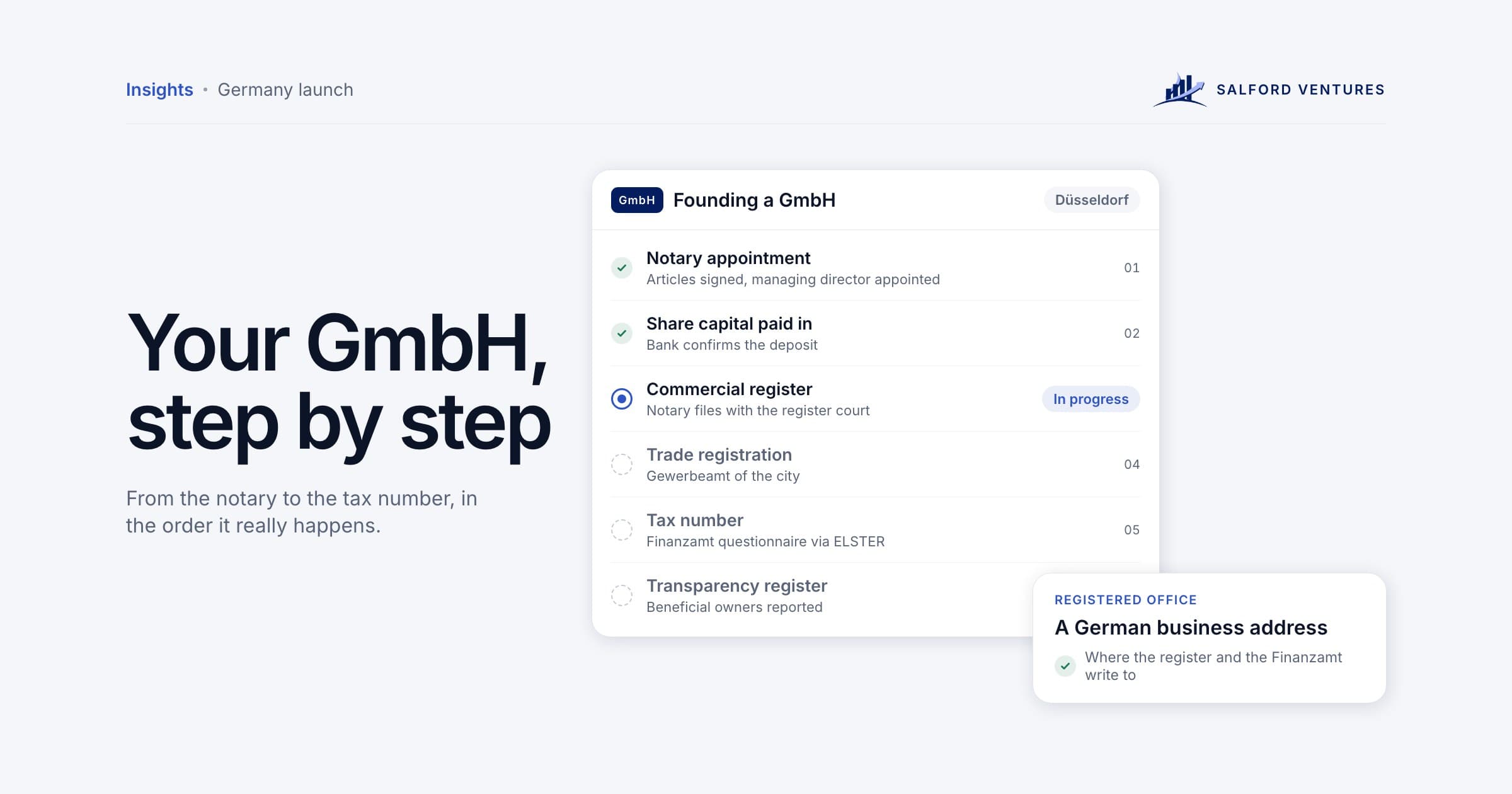
To set up a GmbH in Germany as a foreigner, you agree the company's structure, sign its articles of association before a German notary (in person, through a proxy or by video), open a business account and pay in at least €12,500 of the €25,000 share capital, and wait for the notary's filing to be entered in the commercial register (Handelsregister). Then you register the business with the trade office and the tax office, report the beneficial owners to the transparency register, and you can trade. You do not need German citizenship or a German residence to own or manage a GmbH.
Below is the full sequence, the documents a non-resident is asked for, the online founding option and its limits, and the mistakes that cost founders from abroad the most time.
Can a foreigner found and run a GmbH?
Yes. The GmbH Act sets no nationality or residence requirement for shareholders or managing directors. A company from abroad can hold the shares, and an individual living in India, the US or anywhere else can be the managing director (Geschäftsführer). German courts dropped the old view that a managing director must be able to enter Germany at any time.
Two things are separate questions. Owning and managing a company from abroad is not the same as living and working in Germany: that needs a residence permit, which we cover in the article for Indian founders. And a managing director carries personal duties, such as keeping proper books and filing for insolvency in time, wherever they live.
The process, step by step
| Step | Who does it | What you need |
|---|---|---|
| 1. Structure and name | You, with your advisers | Shareholders and shares, managing director, company name, registered office in Germany |
| 2. Documents | You | Passports, proof of address, papers of any corporate shareholder, authentication, translations |
| 3. Notary appointment | German notary | Articles of association or model protocol, shareholder list, register application |
| 4. Bank account and capital | Bank, you | Account for the company in formation, capital paid in, payment confirmation |
| 5. Commercial register | Notary files, court registers | The notary's electronic filing; the court's entry |
| 6. Trade office | You or your adviser | Gewerbeanmeldung at the city where the company sits |
| 7. Tax office | Usually your tax advisor | Tax registration questionnaire via ELSTER; tax number, VAT ID |
| 8. Transparency register | Managing director | Beneficial owners reported at transparenzregister.de |
1. Decide the structure and the name
Decide who holds how many shares, who is managing director, where the registered office (Sitz) is and what the company is called. The name must be distinctive and must include "GmbH". Chambers of commerce check proposed names on request; the register court decides. The registered office must be a German address where letters actually reach you: the court, the tax office and the bank write by post.
2. Articles of association or the model protocol
Simple set-ups with up to three shareholders and one managing director can use the statutory model protocol (Musterprotokoll), a fixed template that is quicker and has lower notary fees. It cannot be changed, so anything beyond the basics, such as vesting, leaver rules, investor rights or several managing directors, needs individual articles. If you plan to raise money, discuss that with the notary before choosing the template.
3. The notary appointment
A GmbH is founded by notarial deed. The notary reads the deed aloud; if you do not speak German well enough, the Notarisation Act requires a translation, usually by an interpreter, and you can ask for a written translation. Many notaries prepare bilingual deeds. At the same appointment the managing director signs the application to the commercial register and gives the statutory assurances, for example that no court order bars them from managing a company.
4. Bank account and share capital
With the deed, the bank opens an account for the company in formation (GmbH i. G.). Under § 7 GmbHG, a quarter of each cash share and at least €12,500 in total must be paid in before the filing; contributions in kind must be made in full. The bank confirms the payment. Ask banks before the notary appointment whether they accept non-resident managing directors and foreign corporate shareholders, and how they identify them: this is where many foreign founders lose weeks.
5. Entry in the commercial register
The notary files electronically with the register court of the registered office. Once the court enters the company, it exists as a GmbH (§ 11 GmbHG) and the entry is public on handelsregister.de. The court's fee for a cash formation is €225, plus a provisioning fee of a third of that, according to the register fee schedule. Anyone acting for the company before the entry can be personally liable, so time big contracts accordingly.
6 to 8. Trade office, tax office, transparency register
- Trade office: register the business under § 14 GewO with the city's Gewerbeamt; many cities, including in North Rhine-Westphalia, accept it online. The office forwards it to other authorities.
- Tax office: the questionnaire for tax registration must be filed electronically via ELSTER within one month of starting (§ 138 AO). Tick the box for a VAT ID if you trade across EU borders; the Federal Central Tax Office issues it by post.
- Transparency register: a GmbH must actively report its beneficial owners (§ 20 GwG), meaning the people who ultimately hold or control more than 25%. The commercial register entry does not do this for you.
- Chamber of commerce: membership of the local IHK follows automatically for trading companies (§ 2 IHKG).
What non-residents need on top
Documents founders from abroad are asked for most often
- A valid passport for every shareholder and managing director, and proof of private address.
- If you cannot attend: a power of attorney, certified by a notary with an apostille, or by a German consular officer abroad.
- For a corporate shareholder: a current register extract, a resolution approving the German company and naming the signatory, and the chain of ownership up to the natural persons.
- Certified German translations of foreign documents, by a sworn translator.
- A German business address with reliable post handling.
- Your tax identification number at home and a short business description for the bank's due diligence.
Founding online by video
Since August 2022 a GmbH or UG can be founded online through the notaries' video platform, and since August 2023 also with contributions in kind (with exceptions such as real estate). You join the notary by video, identify yourself electronically and sign with a qualified electronic signature. The notary must be locally competent, for example where the company will sit or where a managing director or shareholder lives (§ 10a BNotO).
The limit for many foreign founders is identification. The platform accepts the German ID card, the German electronic residence permit (eAT) and notified electronic IDs from EU countries, according to the notaries' document list. A passport from outside the EU is not enough on its own. If you hold a German residence permit card, the video route can save a trip; otherwise plan for an appointment in person or a proxy.
How long it takes
| Phase | Typical duration | What slows it down |
|---|---|---|
| Structure, name, documents | 1 to 2 weeks | Authentication and translations of foreign papers |
| Notary appointment | A few days to 2 weeks | Notary availability, interpreter, bilingual drafts |
| Bank account and capital | Days to several weeks | Bank due diligence for non-residents |
| Register entry | Days to a few weeks | The court's workload, queries on the documents |
| Trade, tax and transparency registrations | 1 to 3 weeks | Tax office processing, VAT ID by post |
With everything prepared, six to eight weeks from decision to a company that can invoice is a realistic plan. Our free Germany Launch Playbook breaks it down week by week.
Mistakes that cost founders from abroad the most time
- Booking the notary before the documents exist. Missing authentication or translations move the appointment and everything after it.
- Choosing a bank without asking. Some banks do not open accounts for non-resident directors or non-EU parent companies.
- A registered office that does not receive post. Letters from the court and the tax office carry deadlines.
- Forgetting the transparency register. The duty applies from the start and missing reports can be fined.
- No tax advisor until the first deadline. VAT, payroll and transfer pricing decisions are cheaper to get right at the start.
How Salford Ventures helps
Salford Ventures coordinates the launch for founders from abroad: the structure, the documents, the notary appointment, the bank, the tax advisor, the business address and the first German customers, as one plan. Licensed partners do the regulated parts: the notary notarises, the Steuerberater advises on tax. See the Germany Launch service, estimate your costs or book a call.
Ask Salford
Questions about setting up a GmbH as a foreigner? Ask me.
Answers from Salford's own guides, in seconds. A person from the team follows up if you want.